Additive Manufacturing in Series: Which Processes Pay Off and Which Do Not
29 October 2026 · 12 min read

Editorially responsible: Leon J. Hermann
Written by the Amplifa Marketplace editorial team with AI assistance
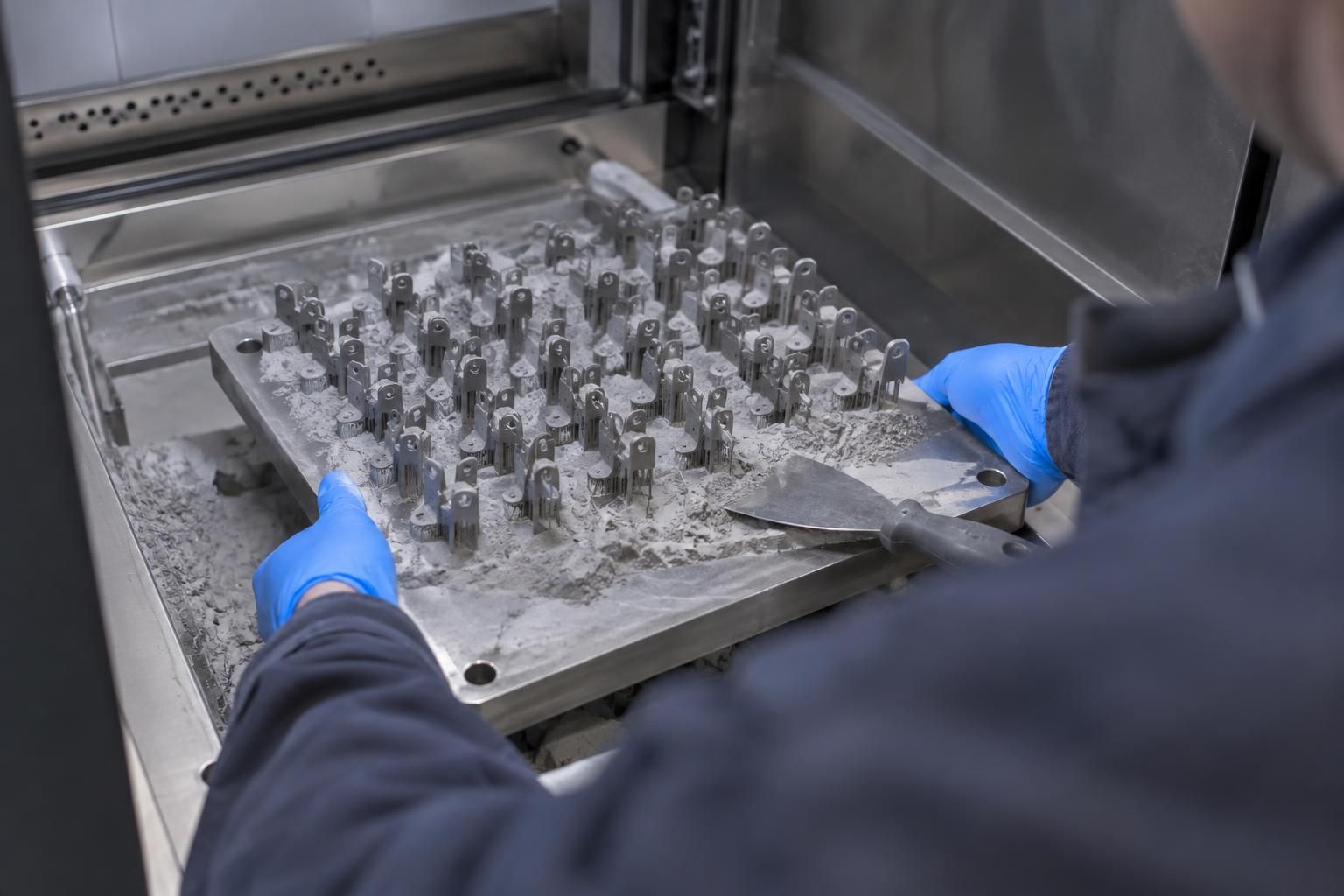
A structured comparison of additive manufacturing processes for mass production: criteria, strengths and weaknesses of PBF-LB/M, MJF, SLS, FDM, SLA and Binder Jetting, cost structures and a reasoned decision guide.
Current Situation: 3D Printing is no longer solely a prototyping process
Only a few years ago, the statement that 3D printing was suitable for prototypes but unsuitable for series was considered established knowledge. The current data suggests a different reality. In a global survey by Essentium, the proportion of surveyed manufacturers producing hundreds of thousands of parts additively has nearly quintupled from 4 percent in 2018 to 24 percent in 2021. Simultaneously, the proportion of companies using 3D printing for fewer than ten parts dropped from 17 percent to 1 percent.
For the technical procurement specialist, the starting question changes. It is no longer about whether additive processes are series-capable, but for which components, batch sizes, and industries they are economically viable compared to conventional methods. This comparison focuses precisely on that. It evaluates established processes using traceable criteria, demonstrates their strengths and weaknesses, and concludes with a reasoned decision on which process is suitable for which target group.
A preliminary note: Robust unit cost comparisons between processes are highly dependent on the respective component. The research material provides few generally applicable figures. Where specific values are missing, this article provides qualitative statements or refers to documented individual cases without deriving general cost rates from them.
Assessment Criteria: How to Measure Viability in Series
Those weighing additively manufactured series parts against conventional processes or other printing methods need a consistent set of criteria. From the research material, five mutually reinforcing criteria can be derived.
- Cost Structure: Process cost accounting divides costs into direct and indirect components. For PBF-LB/M, the Laser Powder Bed Fusion with Metal, the main drivers, according to the Fraunhofer Future Factory, are usually machine costs, which depend on build time and machine hourly rates, and material costs, which depend on raw material costs.
- Cost Transparency and Predictability: High and unpredictable production costs hinder the acceptance of additive manufacturing, according to Fraunhofer. A robust cost model must map total costs at both the factory and supply chain levels.
- Technology Scalability: The Essentium survey names the improved scalability of 3D printing technology as one of the essential drivers over the last two years, citing 39 percent of respondents.
- Component Benefit: According to the survey, performance enhancement of parts (55 percent), design freedom (45 percent), and overcoming supply chain issues (30 percent) are the most important motives for deployment in mass series. Pure cost savings rank fourth at 24 percent.
- Material Availability: 33 percent of respondents view the long-term availability of materials for parts and tool design as a strategic consideration for future-proof investments.
This sequence of criteria is no accident. The most important reason for application is not the unit price, but the functional added value of the component. Those who view additive manufacturing only as a cheaper injection moulding replacement will be disappointed in most cases. Those who evaluate it as a process for high-performance geometries will find the economically viable applications.
The Candidates: Six Processes at a Glance
The comparison covers six processes that are considered for series parts in practice. Their classification is based on the process descriptions in the research material.
- Stereolithography (SLA): The first additive process established on the market. A liquid resin is hardened under the influence of ultraviolet light. Relevance for series parts is primarily in plastic components with fine details.
- Selective Laser Sintering (SLS): Developed in the late 1980s at the University of Texas. A laser combined with plastic powder creates components without a mold; the powder bed supports the component itself.
- Fused Deposition Modeling (FDM): Layer-by-layer melting and deposition of plastic. Popular due to simple and cost-effective handling, suitable for model building and small series.
- Binder Jetting: A liquid binder is sprayed onto a powder bed, which then solidifies. This enables high build volumes per process run.
- PolyJet or Material Jetting: The research material describes a laser on a bed of metal powder, allowing prototypes and fully functional end products to be produced from metal within a few days.
- Laser Powder Bed Fusion with Metal (PBF-LB/M): The metallic powder bed process, for which Fraunhofer developed a structured cost model and which is particularly used in aerospace, medicine, and custom manufacturing.
Additionally, a powder bed process using polymer as a building block is relevant for industrial mass series: The North American manufacturing service provider Addman is building its fleet of HP Multi Jet Fusion systems to over 125 units, including 81 additional Jet Fusion 5620 Pro systems. A fleet of this magnitude demonstrates that polymer powder bed manufacturing is planned as an industrial capacity asset for the series today, not as an experiment.
Strengths and Weaknesses of the Processes in Detail
PBF-LB/M: High Functional Value, High Cost Dynamism
The strength of metallic laser melting lies in the geometric freedom, which allows for complex, lightweight, or high-performance shapes. A documented case from the aerospace industry shows this specifically: titanium parts for spacecraft became 66 percent lighter through metal 3D printing. The weakness lies in the cost structure. According to Fraunhofer, machine costs, driven by build time and machine hourly rate, and material costs were dominant in PBF-LB/M. These are supplemented by higher design and testing costs and less mature production processes compared to conventional manufacturing. Calculation is challenging because costs are influenced by several interdependent variables, including material usage, machine parameters, and batch sizes.
SLS and MJF: The Workhorses of Polymer Mass Series
Powder bed processes using plastic excel in series because many parts can be built simultaneously in the powder bed without support structures. The Addman fleet of over 125 HP MJF systems confirms industrial scaling. For the buyer, fleets of this size mean something concrete: there is a service market with considerable capacity, availability for series volume, and the possibility of capacity balancing across several suppliers. The weakness lies in the material spectrum and the surface properties of typical powder materials, for which the research material provides no robust detailed statements.
SLA and FDM: Precise or Inexpensive, but Weaker Scaling
SLA delivers finely resolved plastic parts based on its process principle. FDM is widely available due to its simple and cost-effective handling, and the research material places it in the prototyping and small series categories. Both processes are thus more interesting for medium volumes and spare parts than for functional components manufactured in the hundreds of thousands. This does not mean FDM is impossible in series, but the documented mass series cases come from other process families.
Binder Jetting and Material Jetting: Volume Versus Control
Binder Jetting allows powder beds to be solidified over a large area, enabling many parts to be manufactured per cycle, reducing the build time per piece. Metallic material jetting, as described in the research material, enables fully functional metal end products within days. For a comprehensive evaluation of series capability, material quality, and the cost position of both processes, the research material provides no further data. Therefore, it remains consciously reserved in its classification compared to others.
What Documented Series Cases Actually Prove
Instead of abstract cost models, it is worth looking at the case studies documented in the research material. They show where additive manufacturing is economically viable in series today.
- A 3D-printed redesign of a suction gripper achieved 94 percent weight savings, 50 percent cost savings, and increased functionality, according to the user report.
- Titanium inserts for spacecraft were manufactured 66 percent lighter using metal 3D printing.
- Shree Rapid Technologies reduced resin consumption for support structure generation by 50 percent using software tools, a direct lever on material costs.
- Marchesini Group accelerated resin and metal 3D printing by 30 percent.
- Signify used 3D-printed components on a light bulb assembly line, increasing efficiency and productivity according to the case study. Senior Mechanical Design Engineer Danny Van der Jonckheyd stated: "Additive manufacturing has greatly helped us improve efficiency in mass production while simultaneously reducing our costs."
- CommScope doubled its production figures within a week, according to the case study.
Common Pattern in These Cases: The economic advantage is almost never achieved through the unit price of an existing component, but through a redesign that utilizes additive freedom. The suction gripper was not printed because printing was cheaper than injection moulding of the old design, but because the new design was lighter, more functional, and ultimately cheaper. For procurement, this means: the evaluation of an additive series part begins with the design, not with the request for a quote.
Cost Model: How Viability Can Be Calculated
The Fraunhofer Future Factory research project KISS developed a cost model for PBF-LB/M based on process cost accounting. The approach distinguishes between direct costs, which can be attributed directly to a product, and indirect costs, which must be allocated according to causality. Costs are broken down into detailed factors, such as material and energy costs, and directly calculated against product- or process-oriented variables like material and energy consumption. This transparent approach shows cause-effect relationships and makes cost drivers and optimization potential visible.
For procurement practice, this follows a practical principle: ask for a cost breakdown. An additive manufacturing service provider who only names a unit price is difficult to compare with a conventional quote because the cost drivers build time, machine hourly rate, material consumption, and post-processing carry different weights. In conventional manufacturing, the cost estimate follows a clearly defined structure according to Fraunhofer, which is not the case with additive manufacturing. Anyone who wants to compare quotes needs a unified grid that separates at least material costs, machine costs, post-processing, and qualification effort. Such a comparison can be built through structured requests, which, for example, the B2B marketplace Amplifa supports for technical procurement specialists.
The Fraunhofer authors additionally identify two cost risks that are often underestimated in series calculations: higher design and testing costs and less mature production processes compared to conventional manufacturing. Both belong in the TCO assessment and must not be reduced to the unit price of the printed part.
Comparison Table: Process Overview
The table summarizes the current state of the evaluation. It deliberately uses documented statements from the research material and leaves cells open where robust values are not available.
| Process | Material | Documented Scaling in Material | Documented Strengths | Documented Weaknesses or Open Issues |
|---|---|---|---|---|
| PBF-LB/M (Metal Powder Bed) | Metal powder, e.g. titanium in case studies | Cost model available, applications in aerospace, medicine, custom manufacturing | Complex, lightweight, performance-optimized geometries; case study 66 percent lighter | Machine and material costs as main drivers, higher design and testing costs, less mature processes |
| HP Multi Jet Fusion (Polymer Powder Bed) | Polymer powder | Fleet expansion by Addman to over 125 systems, including 81 new Jet Fusion 5620 Pro | Industrial capacity in service provider scale | No robust cost or material data in the research material |
| SLS | Plastic powder | Developed in the late 1980s, industrially established | Tool-free series parts in the powder bed | No specific series figures in the research material |
| SLA | Liquid resin, UV curing | First established additive process | Fine details, resin consumption per software reducible by 50 percent (support structures) | No mass series documentation in the research material |
| FDM | Plastic filament | Widely used due to simple handling | Cost-effective handling, prototypes and small series | Research material places it in prototyping and small series |
| Binder Jetting / Material Jetting | Powder bed with binder or metal | Fully functional metal end products possible in days | High number of parts per cycle possible | No cost or series data in the research material |
Suitability by Target Group: Who Should Investigate What
Procurement Specialists in Aerospace and Medical Components
For this target group, PBF-LB/M is the first candidate, because the documented applications are exactly in this field and the functional benefit, such as 66 percent weight savings in titanium parts, can justify the higher manufacturing effort. The calculation discipline according to the Fraunhofer Model is crucial: separating direct and indirect costs, modeling machine and material costs as main drivers, and including the supply chain level.
Procurement Specialists in Mechanical Engineering and Electrical Industry
Polymer powder bed processes and SLA are more realistic here. The Signify case shows that 3D-printed components on assembly lines can measurably improve efficiency and productivity. The CommScope case shows that production figures can double in a short time if additive capacity is available. Investigate manufacturing aids, custom parts, and small to medium functional parts before considering core components.
Managing Directors of Supplier Businesses
For providers, the question is reversed: Is the establishment of additive series capacity worthwhile? The Essentium survey provides three points of reference. First, the market for mass series is measurably growing, from 14 percent of respondents in 2020 to 24 percent in 2021 who manufacture hundreds of thousands of parts additively. Second, 96 percent of respondents see a billion-euro saving potential for the manufacturing industry with the further development of the technology. Third, respondents name integration into existing manufacturing plants (50 percent), specialized design expertise (39 percent), deeper financial department understanding of cost impacts (38 percent), and long-term material availability (33 percent) as strategic conditions. According to these data, capacity expansion without accompanying competence building in design and calculation is of little purpose.
Supply Chain Managers with Supply Chain Risk
30 percent of respondents name overcoming supply chain issues as an adoption motive. Additive manufacturing enables flexible and decentralized production possibilities, a point that the Fraunhofer analysis explicitly emphasizes in the context of the Coronavirus pandemic. For securing critical parts, this can be an independent business case, regardless of the unit price comparison.
A Reasonably Founded Decision: The Path to Viable Selection
The combined evaluation leads to a clear recommendation logic that can be derived from the documented data.
- First, check the functional added value, not the unit price. In the survey, the performance enhancement of parts ranks first among adoption motives at 55 percent, while cost savings rank fourth at 24 percent. Redesign-capable parts with weight benefits are the viable candidates.
- Choose the process based on material and batch size. Metal and complex geometries lead to PBF-LB/M; polymer in medium to large volumes leads to powder bed processes like MJF or SLS; small series and auxiliary parts lead to FDM or SLA.
- Demand a cost breakdown from every provider based on process cost accounting. Without separate positions for material, machine time, post-processing, and qualification, a comparison is neither serious against other additive providers nor against conventional manufacturing.
- Evaluate the scalability of the supplier's capacity. A system is an investment, a fleet like Addman's with over 125 MJF systems is an industry. For series volume with delivery commitment, you require providers with a corresponding plant base.
- Establish monitoring of material availability, which 33 percent of respondents name a strategic condition, and anchor the cost impacts in financial evaluation, which 38 percent name a success factor.
The final classification: additive manufacturing is economically viable where it delivers components that cannot or can only be produced conventionally with high effort, and where a cost model makes the cost drivers transparent. It remains critically examinable where it is offered merely as a replacement for existing conventional parts without redesign. The research material is clear on this: all documented success stories start with the design. Dr. Blake Teipel, CEO of Essentium, formulates the direction as: "Additive technology is now advanced enough that manufacturers all over the world can digitally print parts on demand, at a speed, scope, and cost-effectiveness that challenges conventional methods." For the technical procurement specialist, this means specifically: evaluate the processes using the five mentioned criteria, demand the cost breakdown, and begin with components whose function improves through additive design.
Sources
- Entwicklung eines strukturierten Kostenmodells für die Additive Fertigung (PBF-LB/M)Kostentreiber Maschinen- und Materialkosten bei PBF-LB/M, Prozesskostenrechnung mit direkten und indirekten Kosten, hinderliche unvorhersehbare Kosten, Anwendungen Luft- und Raumfahrt, Medizin, kundenspezifische Fertigung
- Additive Fertigung ist mittlerweile Verfahren der Serienfertigung (Essentium-Studie)Umfragewerte: 4 auf 24 Prozent Großserienfertiger, 14 auf 24 Prozent 2020 auf 2021, 1 vs. 17 Prozent Kleinstserien, Einführungsmotive 55/45/30/24 Prozent, Treiber 47/42/40/39 Prozent, 96 Prozent Einsparpotenzial, strategische Bedingungen 50/39/38/33 Prozent, Zitat Blake Teipel
- Additive Fertigung in die Serienproduktion integrieren (Materialise)Fallstudien: Sauggreifer 94 Prozent leichter und 50 Prozent günstiger, Titaneinsätze 66 Prozent leichter, Shree Rapid Technologies 50 Prozent Harzersparnis, Marchesini Group 30 Prozent schneller, Signify-Zitat, CommScope Verdopplung der Produktionszahlen
- Additive Fertigung: der 3D-Druck digitalisiert die FertigungVerfahrensbeschreibungen SLA, SLS, FDM, Binder Jetting, Material Jetting, Abgrenzung additiv/subtraktiv, Anwendungen Medizin und Luft- und Raumfahrt
- Additive Fertigung für die Serienproduktion (industrie.de)Flottenausbau von Addman auf über 125 HP MJF Systeme mit 81 zusätzlichen Jet Fusion 5620 Pro Anlagen, Stratasys-Förderung zur Skalierung additiver Serienfertigung
Editorially responsible
Leon J. Hermann
COO & Co-Founder at Amplifa
As COO and co-founder, Leon is responsible for scaling Amplifa's operations.
View profileResearched from publicly available sources and automatically checked for completeness; not individual professional advice.
Get multiple quotesLatest articles
Capacity reservation at suppliers: framework agreement, call-off order or capacity binding compared
Framework agreement, call-off order and capacity binding compared: mechanics, strengths and weaknesses for supply security with critical parts, without paying for overcapacity.
27 October 2026 · 9 min read
Local is always more expensive? When the DACH supplier actually wins at total cost level
The unit price rarely lies, but it only tells part of the story. An opinion piece on which cost items come into play in long-distance sourcing from Asia, when the DACH supplier wins anyway, and how to compare the two cleanly.
25 October 2026 · 14 min read
Injection Moulding Manufacturers in the DACH Region: Market Conditions, Capacities, and Insolvency Risks in the Trend Report
Market analysis for buyers: Capacity utilization, insolvency risks, and order status among plastic processors in the DACH region, with consequences for supplier selection and price negotiation.
23 October 2026 · 10 min read